.png&w=1280&q=75)
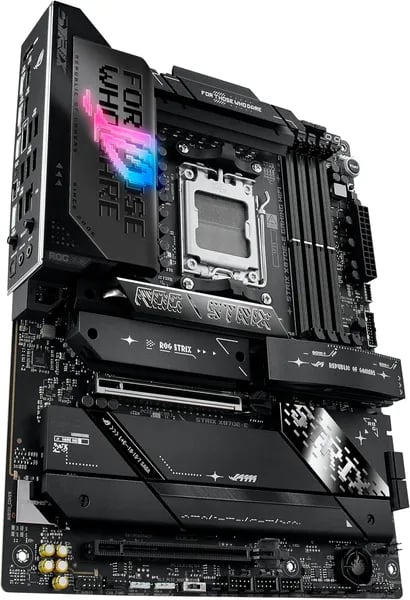
You’re standing over a box with a shiny new CPU and a stack of components — the thrill of a fresh build. I remember my first AM5 board and how baffled I felt by specs sheets; here, you’ll get a clear, no-nonsense roadmap for the ASUS ROG Strix X870E-E. I’ll walk you through what matters (and what’s fluff), toss in a few real-world impressions, and even imagine a slightly ridiculous—yet useful—WiFi 7 streaming experiment. Spoiler: this board wants to be future-proofed.
1) Raw Power & Overclocking: VRM, Power Stages, and Memory
18+2+2 VRM and 110A Power Stages: built for Ryzen 9000 stress
If you’re pairing an AMD Ryzen 9000 chip with serious boosting or manual tuning, the ROG Strix X870E-E is designed to keep power delivery steady. Its 18+2+2 VRM layout uses Power Stages rated at 110A each, which matters when your CPU pulls hard during long renders, heavy gaming sessions, or AI-style workloads that don’t let up.
Alex Morgan, Senior Editor at TechBench: "The X870E-E’s VRM is a serious statement — stable under long synthetic loads and friendly to high-core-count Ryzen chips."
VRM Design and cooling: heatsinks + L-shaped heat-pipe
Raw power is only useful if temperatures stay under control. This board’s VRM Design leans on massive, optimized heatsinks and an L-shaped heat-pipe to spread heat across more surface area. That helps you hold higher clocks for longer, instead of bouncing off thermal limits when the load ramps up.
In practical terms, you get a platform that’s more comfortable with sustained boosting and overclocking—especially helpful if you’re running higher-core-count Ryzen parts or pushing PBO-style tuning.
DDR5 Memory: AEMP Technology, EXPO, and what to verify
For DDR5 Memory, you’re covered with AEMP Technology (ASUS Enhanced Memory Profile) and you’ll also want to shop smart around AMD EXPO kits. Memory support is where specs can look inconsistent depending on the source:
- Capacity: the source notes up to 192GB, while other spec sheets/insights mention up to 256GB.
- Speed: one listing mentions 320 MHz, but enthusiast specs often point to 8000+ MT/s OC potential (platform and CPU dependent).
Your best move: check the board’s QVL (memory support list), confirm your kit is validated for EXPO/AEMP, and keep BIOS updated before you chase high-frequency DDR5 tuning.
2) Connectivity & Storage: PCIe, M.2, Ethernet, USB and WiFi 7
PCIe 5.0 expansion for today’s GPUs (and tomorrow’s)
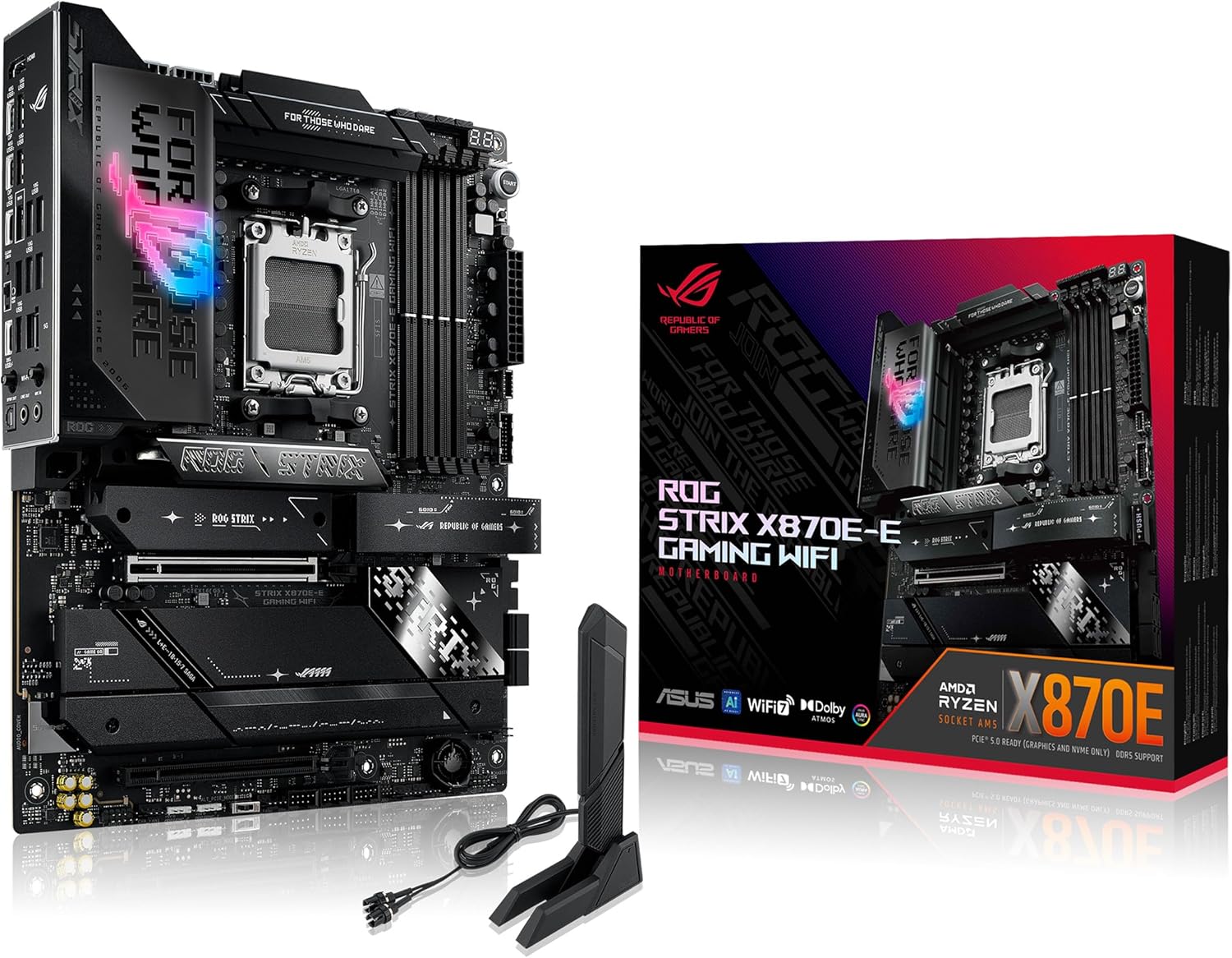
With the ROG Strix X870E-E, you’re building on a platform that’s ready for next-gen bandwidth. You get Dual PCIe 5.0 x16 SafeSlots, reinforced to handle heavy graphics cards without flex. The primary slot runs PCIe 5.0 x16, so your current GPU won’t be held back, and future cards have room to stretch. If you like advanced setups, you can also take advantage of lane splitting (bifurcation) for certain add-in cards and storage adapters.
M.2 Slots and Storage Slots: five NVMe bays + SATA flexibility
Storage is where this board really feels “future-proof.” You get 5 M.2 Slots total: 3x PCIe 5.0 and 2x PCIe 4.0, plus 4x SATA 6Gb/s. That’s a lot of Storage Slots for a clean, cable-light build—especially if you’re juggling games, project files, and backups.
Those three PCIe 5.0 M.2 slots are the standout: you can run multiple ultra-fast drives at the same time—great for an OS drive, a dedicated scratch disk, and a separate workspace drive without bottlenecks.
Maya Patel, Senior Systems Engineer: "Having three PCIe 5.0 M.2 slots on a single board is a real productivity multiplier for creators."
- NVMe RAID support for speed-focused arrays or redundancy
- Room for OS + apps, active projects, and archive drives without compromise
Networking: WiFi 7 + 5Gb Ethernet for high-throughput work
For networking, you’re covered whether you’re wired or wireless. WiFi 7 (802.11be) helps push higher throughput and lower latency for streaming and large transfers on a modern router, while Realtek 5Gb Ethernet is ideal for fast NAS moves and big uploads. If you run Linux, keep in mind WiFi 7 driver maturity can vary by distro.
USB4 Ports and modern Type-C I/O
Your rear I/O includes dual USB4 Ports (Type-C, 40Gb/s)—perfect for modern docks, fast external SSDs, and high-end peripherals. You also get a front-panel 20Gbps Type-C, multiple 10Gbps USB ports, and Power Delivery 3.0 for convenient Type-C power support.
3) AI & Software Helpers: ASUS Smart Features and Q-Design
AI Overclocking + AEMP Technology: fast performance without the guesswork
If you want Ryzen 9000 speed but don’t want to micromanage voltages, AI Overclocking is the shortcut. It reads your CPU cooling headroom and power limits, then suggests a stable boost path you can apply in BIOS or software. Pair that with AEMP Technology (ASUS Enhanced Memory Profile), and your DDR5 setup becomes much less stressful—especially if you’re not used to tuning memory timings by hand. The big win: these AI tools reduce manual tuning time and lower the barrier to getting optimized performance.
AI Cooling II + AI Networking II: quieter fans, smoother online play
AI Cooling II helps you dial in fan curves automatically, so your system stays cool under load without sounding like a vacuum. AI Networking II focuses your bandwidth where it matters—games, voice chat, or streaming—so background downloads don’t ruin your ping.
- Dynamic OC Switcher: flips between all-core and boost behavior based on load.
- Core Flex: fine-tunes how the CPU behaves under different temps and power states.
- PBO Enhancement: makes Precision Boost Overdrive easier to use safely.
Liam Chen, Community Moderator at BuildRight: "The combination of AI helpers and Q-Design makes assembly and tuning approachable for both first-time builders and veterans."
ASUS Q-Design: fewer tiny annoyances during the build
ASUS Q-Design is all about speed and fewer “why won’t this fit?” moments. Q-Release Slim makes GPU removal easier, while M.2 Q-Latch lets you secure SSDs without hunting for tiny screws. For troubleshooting, Q-Code and Q-LED give you quick clues when a boot issue happens. And the pre-mounted I/O shield saves time and finger pain.
Armoury Crate + mature BIOS + support you can lean on
With a more polished Armoury Crate and a mature ASUS BIOS, you get a cleaner dashboard for drivers, updates, and system control. Add Amazon fulfillment, free Prime shipping, and holiday returns eligible until January 31, 2026, and you can buy with extra confidence—backed by ongoing ASUS updates and customer support.
4) Real-World Impressions, Comparisons, and Caveats
What builders notice with AMD Ryzen (especially Ryzen 9000 Series)
In real builds, the ROG Strix X870E-E tends to feel “fast” in the ways you actually notice: quicker game loads, smoother multitasking, and fewer weird stability hiccups after tuning. Users across regions—from Brazil to Saudi Arabia—often report 20%+ performance uplifts when moving from older AMD boards or Intel setups, especially when pairing it with a chip like the Ryzen 7 9800X3D. That lines up with what you’d expect from a modern platform: stronger power delivery, better memory behavior, and more bandwidth for storage and I/O.
Sofia Alvarez, PC Enthusiast & Reviewer: "Switching to the X870E-E felt like giving my rig a new heart — better thermals, more storage lanes, and fewer bottlenecks."
Value signals: ranking, pricing, and common bundles
On Amazon, it’s been sitting around #7 in Computer Motherboards, which usually means you’re not alone if you run into a setup question. Pricing is also a big part of the appeal: $359.99 new, occasional used units at $316.04, versus a $499 list price. A common “easy mode” cart pairs it with:
- AMD Ryzen 7 9800X3D (~$456)
- ARCTIC MX-4 thermal paste (~$5.48)
Comparisons: when alternatives make more sense
If you don’t need WiFi 7 or you’re trying to hit a different budget, competitive options exist. The ROG Crosshair X670E Hero is a frequent comparison point, offering 18+2 phase power, DDR5-6400 OC (128GB), PCIe 5.0, USB4, Intel 2.5G, and WiFi 6E. If you want a tiny footprint instead of an ATX build with multiple M.2 Slots, some buyers also cross-shop Mini PCs from GEEKOM and TOPGRO.
Caveats: EXPO Profiles, Linux WiFi, and arrival checks
- EXPO Profiles: Always verify your DDR5 kit is on the QVL or widely confirmed working—memory compatibility is the #1 avoidable headache.
- Linux wireless driver state: Early WiFi 7 support can lag on some distros; check current driver reports before you commit.
- Inspect on arrival: Look for bent pins, damaged boxes, or missing accessories—shipping/vendor issues do happen.
Overall sentiment is strong—about 4.2 stars with roughly 72% 5-star reviews—and features like 5Gb Ethernet and plentiful storage lanes tend to be the “daily wins” you’ll appreciate long after the first boot.
5) Wild Cards: Hypothetical Uses, Tiny Tangent, and Final Buy Checklist
Wild Card: WiFi 7 “8K Multi-Cam” at Home (Mostly to Prove a Point)
Picture this: you’ve got a Ryzen 9000 rig on the ROG Strix X870E-E Gaming WiFi board, and you try to run a live 8K multi-camera stream across your home network. Is that realistic for most people? Not even close. But it’s a clean way to show what this platform is really built for: bandwidth headroom.
Between WiFi 7, 5Gb Ethernet, and storage that can scale with PCIe 5.0 M.2 drives, you’re not just “fine for gaming.” You’re set up for niche workflows like multi-camera editing, high-res streaming, and fast project shuttling—especially if you build out NVMe RAID for scratch disks and media caches.
Noah Rivera, Streamer/Content Creator: "When my workflow moved to multi-track 8K proxies, the extra M.2 lanes and 5Gb link saved me hours each week."
Tiny Tangent: Aura Sync Is Cool, But Airflow Pays the Bills
Yes, Aura Sync looks great when everything glows in perfect harmony. But synchronized lighting won’t save you from a GPU dumping heat into a case with weak intake. If you’re choosing between extra fans or extra RGB strips, pick airflow first. Your boost clocks (and your sanity) will thank you.
Final Buy Checklist: What You Do the Moment the Box Lands
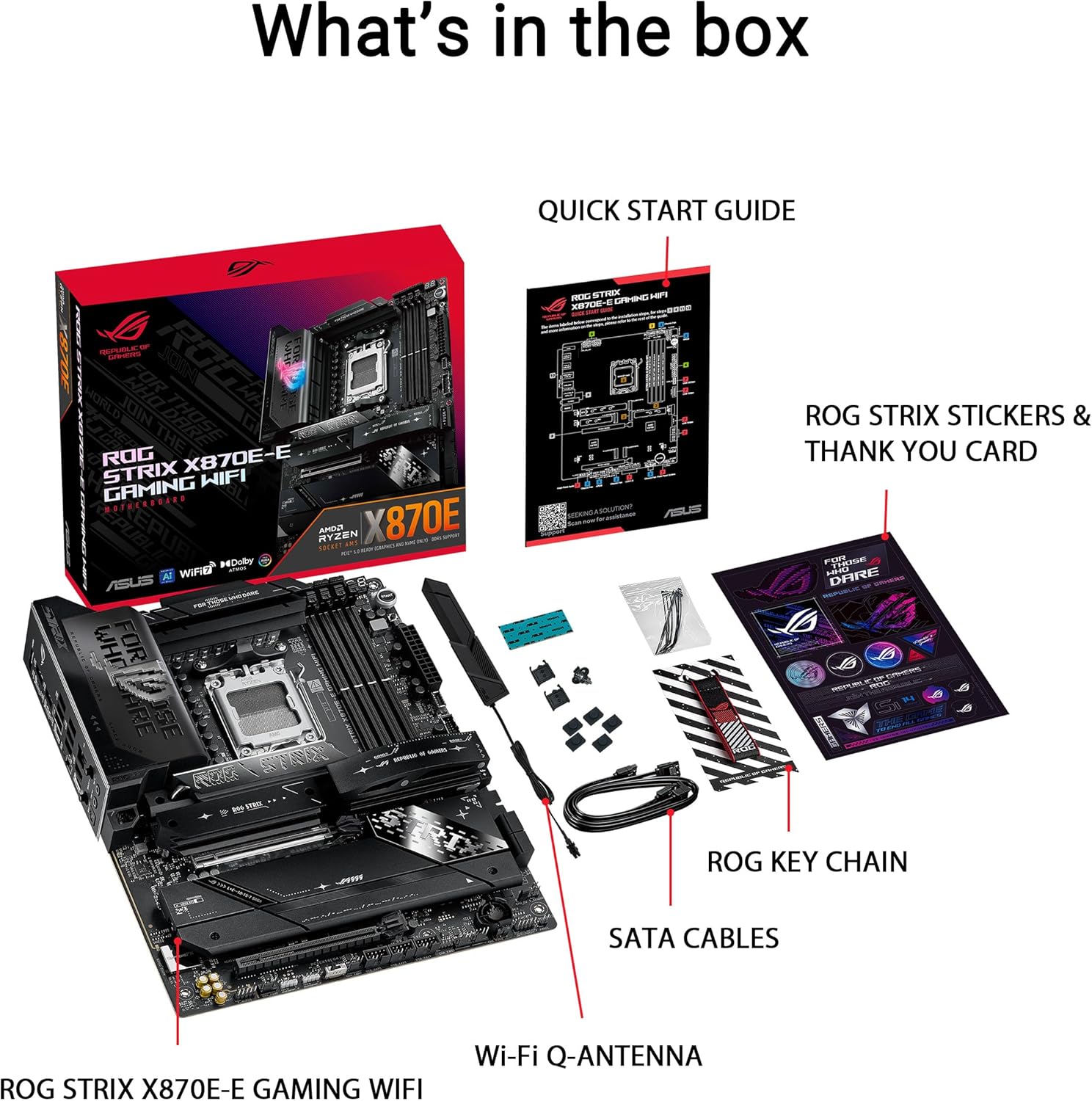
Before you celebrate, do the boring stuff that prevents the common arrival-time headaches. First, validate your DDR5 kit against the board’s QVL and prioritize EXPO Profiles if you want the smoothest “set it and go” memory setup. Next, plan your M.2 layout: decide which slots get your fastest PCIe 5.0 drives, where your PCIe 4.0 storage lives, and whether you’ll run NVMe RAID—because heatsink coverage and lane sharing can change your best layout.
Then, confirm you’re on a BIOS version that fully supports Ryzen 9000 before you start tuning features like PBO Enhancement or Dynamic OC Switcher. Inspect the board for shipping damage, check that accessories and M.2 thermal pads are present, and keep your order info handy—Amazon’s extended holiday returns (through January 31, 2026 on eligible purchases) can be a lifesaver. Finally, be honest about your network: if your router and clients aren’t WiFi 7-ready, WiFi 6E may already be “fast enough.” And if you’re on Linux, check current wireless driver status before you buy.