.png&w=1280&q=75)
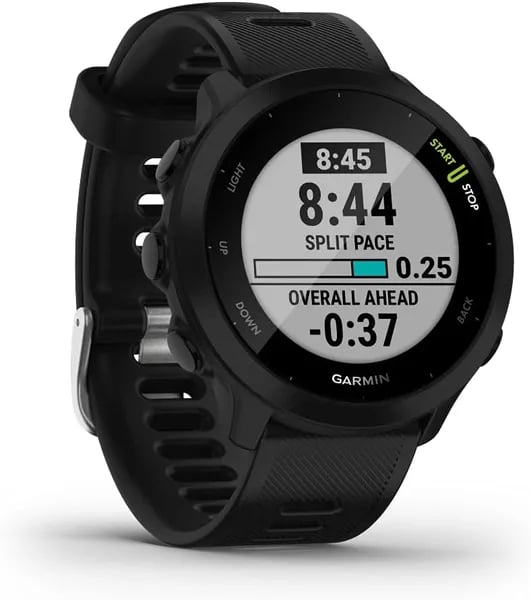
You know that moment when you lace up for a 5K and realize your watch is dead? That happened to me once at dawn—an expensive lesson in judging features over battery. Enter the Garmin Forerunner 55: simple, steadfast, and built to keep going. In this post you’ll get the lowdown on what actually matters for training, the tiny quirks that might surprise you, and whether this is the watch that’ll stick to your wrist day-in, day-out.
Quick Take: Why the Forerunner 55 Matters to You
If you want a running GPS watch that helps you train with confidence—without draining your wallet or your patience—the Garmin Forerunner 55 (Model 010-02562-00, ASIN B092RCLKHN) fits the sweet spot. At $149.99 (down from $199.99) in Black, Aqua, or White, it’s built for road runners and daily trainers who want the essentials done right.
The Forerunner 55 nails the basics so you can focus on training, not tinkering. — DC Rainmaker
Reliable Forerunner 55 GPS tracking (and workouts that keep you moving)
You’re not buying a mini smartphone for your wrist—you’re buying a tool that supports your runs. Forerunner 55 GPS tracking is designed to be accurate and easy to trust, so your pace, distance, and time don’t feel like guesses. Add in daily suggested workouts and Garmin Coach guidance, and you get structure when you need it—especially if you’re newer to running or getting back into a routine.
- Tracks the basics clearly: pace, distance, time, calories, steps
- 24/7 heart rate monitoring to help you train smarter
- Race tools like PacePro and time predictions for goal days
Garmin Forerunner 55 battery life is the real upgrade
If you’ve ever charged a smartwatch daily, this will feel like a relief. Garmin Forerunner 55 battery life lasts up to 2 weeks in smartwatch mode and about 20 hours in GPS mode—practical for full training cycles, long runs, and even race weekends without constant charging.
Lightweight comfort + clear stats at a glance
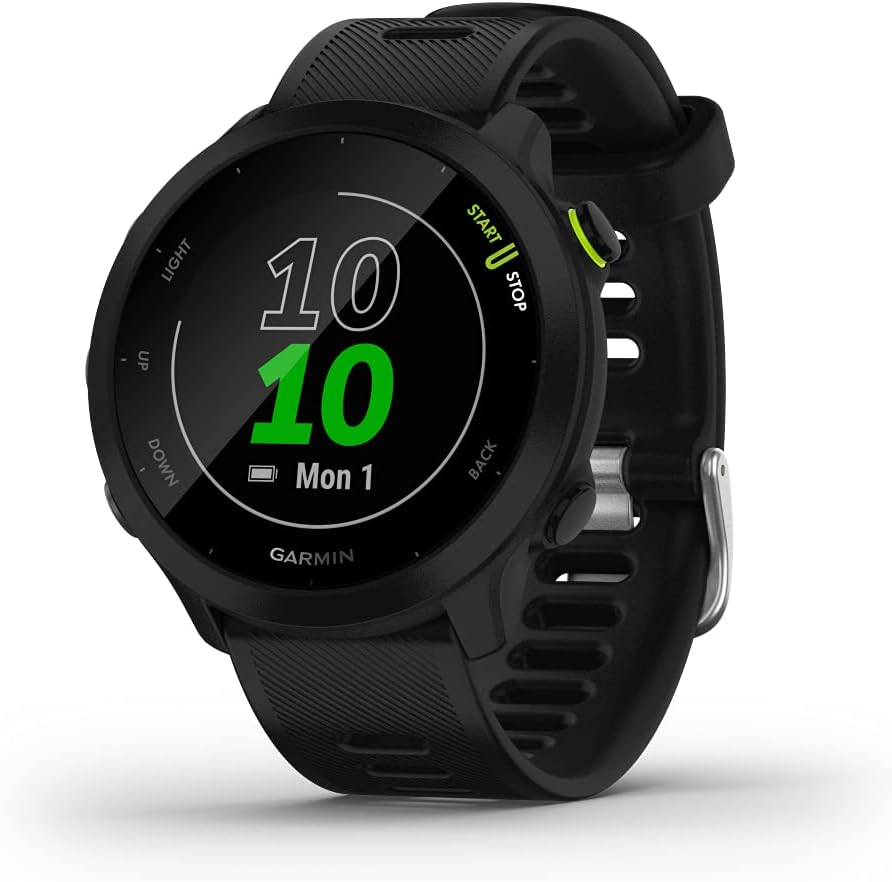
At just 1.31 oz., it stays comfortable on long runs and all-day wear. The 208 x 208 display keeps your key numbers readable mid-stride, and the button controls work well when your hands are sweaty or it’s raining.
More than running when you want variety
You can mix in HIIT, Pilates, cycling, pool swimming, and breathwork profiles—great when you’re cross-training but still want your data in one place.
Garmin Forerunner 55 Specifications (What the Numbers Tell You)
When you look at the Garmin Forerunner 55 Specifications, you’ll notice a theme: everything is built to help you run smarter without adding bulk or distractions. As coach Julie Patterson puts it:
For everyday athletes the spec sheet here is generous—this is mileage-focused engineering, not showpiece hardware. — Julie Patterson, Running Coach
Key Specs that matter on real runs
The headline feature is its multi-GNSS support—GPS, GLONASS, and Galileo. Manufacturer notes and reviewer feedback both point to multi-GNSS improving outdoor accuracy, especially when you’re dealing with tree cover, tall buildings, or changing routes.
- GNSS: GPS + GLONASS + Galileo (better positioning outdoors)
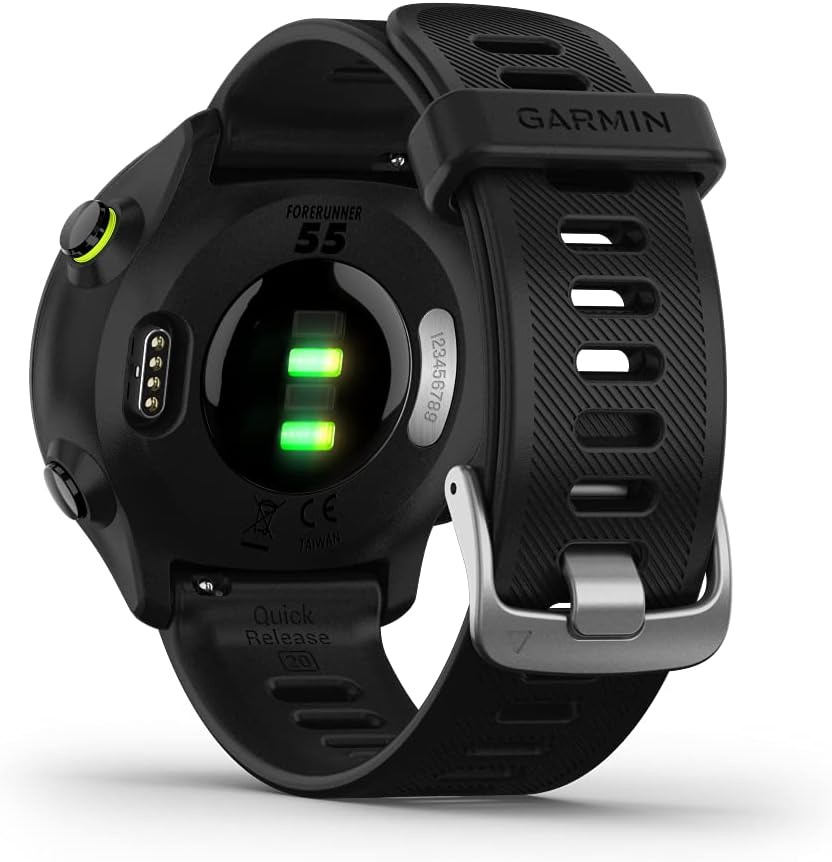
- Sensors: wrist-based heart rate + accelerometer for daily movement and run metrics
- Water rating: 50 m waterproof—strong enough for pool swim tracking
- Sport profiles: running, cycling, pool swimming, HIIT, Pilates, breathwork
Display size and clarity (without a bulky watch)
You don’t need a giant screen to read your pace mid-run—you need a clear one. The Forerunner 55 keeps stats easy to see with a crisp, high-res display.
| Spec | What you get |
|---|---|
| Display resolution | 208 x 208 pixels |
| Design goal | Readable metrics without a bulky case |
Connectivity + lightweight personalization
With Garmin Connect and the Connect IQ store, you can add watch faces, widgets, and simple apps. This is a smart trade-off: you get personalization even though there’s no onboard music storage or contactless payments.
Practical quirks you should plan for
- Button navigation (not a touchscreen): great with sweaty hands, but different if you’re used to tapping.
- Proprietary charging cable: consider ordering a spare for travel.
- Return window: purchases Nov 1–Dec 31, 2025 are refundable until Jan 31, 2026.
Training, Tracking, and Everyday Fitness (What You'll Use Most)
Training that feels personal: suggested daily workouts + Garmin Coach
If you want Training help without paying for a coach, the Forerunner 55 makes it simple. The suggested daily workouts feature is a standout for newer runners because it gives you day-by-day sessions based on your recent activity and recovery. Pair that with Garmin Coach plans, and you can follow a structured 5K/10K build with clear prompts right on your wrist—warm-up, run, recover, repeat.
You also get practical guidance tools that keep you from overdoing it:
- Training status to show if your current effort is productive
- Training load and recovery time so you know when to push and when to rest
It’s not overloaded with advanced metrics—things like running power aren’t included at this price tier—but for most runners, the core coaching cues are what you’ll actually use.
I used suggested workouts for a 10K plan and the pacing nudges actually kept me honest. — Alex Martinez, amateur marathoner
Race-day tools you usually see on pricier watches: PacePro guidance
When you’re training for an event, the Forerunner 55 gives you smart planning help that feels “premium.” PacePro guidance helps you manage effort across a course, so you’re not flying early and fading late. Add in race time predictions and finish-time estimates, and you can set a realistic goal pace based on your current fitness—not wishful thinking.
Everyday fitness tracking that stays out of your way
Outside of runs, it quietly tracks the basics that keep you consistent:
- Steps, calories, and intensity minutes
- Body Battery energy score (influenced by sleep and activity)
- Move IQ auto-detection for common movement patterns
- Wrist heart rate monitoring, sleep tracking, and PulseOx (when enabled)
And when you train indoors, the accelerometer improves treadmill pace/distance estimates over time through self-calibration—so your indoor numbers get better the more you use it. With up to 20 hours in GPS mode, you can log long runs and race days without battery stress.
Real-World Use: Stories, Comparisons, and International Notes
Battery and ease-of-use show up on day one (Forerunner 55 review)
In real training, you don’t care about flashy extras—you care that your watch starts fast, tracks clean, and doesn’t die mid-run. That’s where the Garmin Forerunner 55 keeps winning. With up to 2 weeks in smartwatch mode and 20 hours in GPS, you’ll notice the battery advantage right away compared to many smartwatches. Some runners even report it lasting through three half-marathons on one charge, which is exactly the kind of “set it and forget it” reliability you want for fitness tracking.
I swapped my smartwatch for a Forerunner 55 and finally quit charging every night—best upgrade for my weekend long runs. — Sarah Kim, triathlete
Smartwatch switchers: less “stuff,” more running
If you’re coming from an Apple Watch or a feature-heavy wearable, the Forerunner 55 feels refreshingly simple. You get the essentials—GPS pace, distance, heart rate, suggested workouts, and race tools like PacePro—without the distractions. Yes, you give up premium perks like on-watch music storage or contactless payments, but many users say that trade is worth it for longer battery and button control that works with sweaty hands.
- What you gain: battery life, straightforward menus, runner-first metrics
- What you skip: AMOLED flash, LTE, and luxury materials found in top-tier models
International consistency: Brazil, Mexico, Australia
Real-world reports from runners abroad back up Garmin’s reputation: GNSS performance and build quality hold up globally. Whether you’re logging miles in Brazil, pool sessions in Mexico, or cross-country routes in Australia, you’ll likely appreciate the lightweight comfort (1.31 oz.) and clear 208 x 208 display for quick glances mid-run.
Quick comparison + practical accuracy tip (Garmin Forerunner 55 In-Depth Review)
| Watch | What you’re paying for | Price context |
|---|---|---|
| Forerunner 55 | Runner essentials + battery | $149.99 (often discounted) |
| Premium rivals (e.g., Fenix 8 Pro / Forerunner 970) | AMOLED, LTE, premium build | Up to $1309.99 |
Tip: Wear it snug for better heart rate and sleep readings. Optical sensors can struggle if the fit is loose—or if you have darker wrist tattoos.
With a 4.5-star average from 5,325 reviews, celebrated by 10,000+ Amazon customers, and a #1 rank in Running GPS Units at the time of writing, you’re joining a huge community that values dependable fitness tracking over gimmicks.
Tradeoffs, Tips, and the Small Print (so you don’t get surprised)
What you don’t get: music and payments
The Garmin Forerunner 55 features are built around training, not replacing your phone. That means no onboard music storage and no contactless payments. If you love leaving your phone at home and still want playlists and tap-to-pay, you’ll need to look higher in Garmin’s range. But if your priority is pace, distance, heart rate, and workouts that actually help you improve, this “less is more” approach is exactly why the battery lasts and the watch stays simple.
It’s refreshing to have a watch that focuses on running essentials—if you want media and payments, look higher up the range. — Tom Reynolds, gear editor
EASE OF USE: buttons beat touch (after a day or two)
You’ll control everything with buttons—no touchscreen. The upside is huge during sweaty runs or rainy races: you won’t accidentally pause a workout with a stray swipe. The only tradeoff is a small learning curve at first. Give yourself a couple of sessions to memorize the start/stop and lap buttons, and you’ll likely find the EASE OF USE improves because the watch feels consistent every time.
BIOFEEDBACK tips: great guidance, not perfect truth
The watch’s BIOFEEDBACK—especially sleep tracking and Body Battery—can be super helpful for spotting patterns (like how late caffeine affects recovery). But it’s not gospel. If you’re lying still reading in bed, the sleep monitor may log it as sleep, which can nudge your Body Battery score in the wrong direction. Use these numbers as a guide, then sanity-check them against how you actually feel.
Also, heart rate and sleep accuracy depend on fit. Wear it snug (not tight) above your wrist bone. If you have darker wrist tattoos, the optical sensor may struggle, so expect occasional odd readings.
Charging and returns: the small print that saves headaches
Charging uses a proprietary cable, so it’s smart to pack (or buy) an extra for travel. Finally, if you’re buying as a gift: Amazon notes that purchases made Nov 1–Dec 31, 2025 are returnable for a full refund or replacement until Jan 31, 2026. Bottom line: if you want endurance and simplicity by design, these tradeoffs are easy to live with—and hard not to appreciate.