.png&w=1280&q=75)
I bought my first Wi‑Fi extender years ago because my home office lived in the dead zone. When I tested the TP‑Link RE715X, I expected incremental gains — instead I got clearer rooms, fewer dropped calls, and a reminder that placement matters more than hype. Here’s how this AX3000 unit behaved in my admittedly imperfect living-lab (one dog, one kid, intermittent microwave).
1) Quick Overview: What the RE715X Brings to the Table
When I look at the TP-Link RE715X, it’s clearly built for one job: extending a modern home network without making setup complicated. It’s a dual‑band AX3000 Wi‑Fi 6 range extender that targets people who have dead zones upstairs, in basements, or at the far end of a house and want a solid mid-to-high tier upgrade without jumping to a full mesh kit.
Dual‑band AX3000 Wi‑Fi 6 speeds (with real-world expectations)
On paper, this dual‑band AX3000 extender is rated for up to 2,404 Mbps on 5 GHz and 574 Mbps on 2.4 GHz, for a combined “AX3000” class total of about ~3 Gbps. I treat those as marketing peak numbers—real throughput is usually lower, and wireless repeating often cuts usable speed by around half depending on placement, walls, and router quality.
Coverage 2400 sq ft (claimed) and device capacity
TP-Link lists coverage around 2,400–2,500 sq ft (so, coverage 2400 sq ft in typical search terms). In my experience with extenders, that number can swing a lot based on building materials and interference, but it’s a helpful baseline for what the RE715X is aiming at. It’s also rated to handle up to 64 devices, which fits busy households with phones, TVs, cameras, and smart home gear.
Wired option + flexible modes
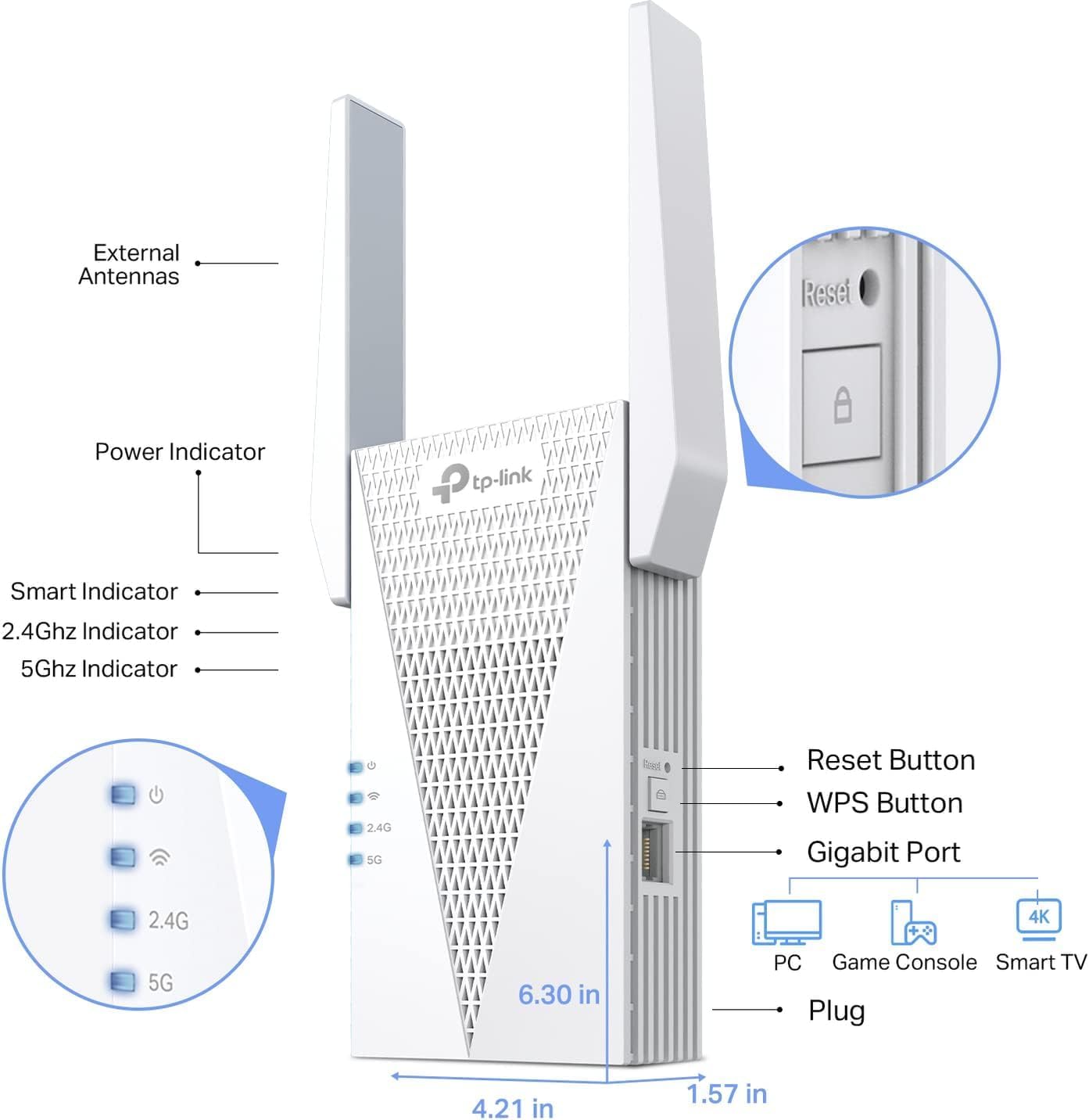
A nice practical touch is the single Gigabit Ethernet port. I can use it to wire in a device (like a console or smart TV) or run the unit in Access Point mode if I have Ethernet available.
EasyMesh compatibility and market positioning
The RE715X supports EasyMesh (and can integrate with compatible OneMesh/EasyMesh routers), which makes expansion simpler. It’s not compatible with TP‑Link Deco mesh systems, so I’d confirm what ecosystem I’m using before buying. It’s also positioned strongly: Amazon’s Choice and PCMag Editor’s Choice, with a common street price around $99.98 (down from $119.99), and used/new options starting near $50.73.
A dependable, future-proof extender for most homes. — PCMag Editorial Team
| Spec | TP-Link RE715X |
|---|---|
| 5 GHz | 2404 Mbps |
| 2.4 GHz | 574 Mbps |
| Combined class | ~3 Gbps (peak) |
| Coverage (claim) | 2,400–2,500 sq ft |
| Devices | Up to 64 |
| Standards/Compliance | IEEE 802.11 a/b/g/n/ac/ax/be; FCC Part 15 |
2) Hardware specifications & real setup (the messy, useful part)
Hardware specifications: what you actually get
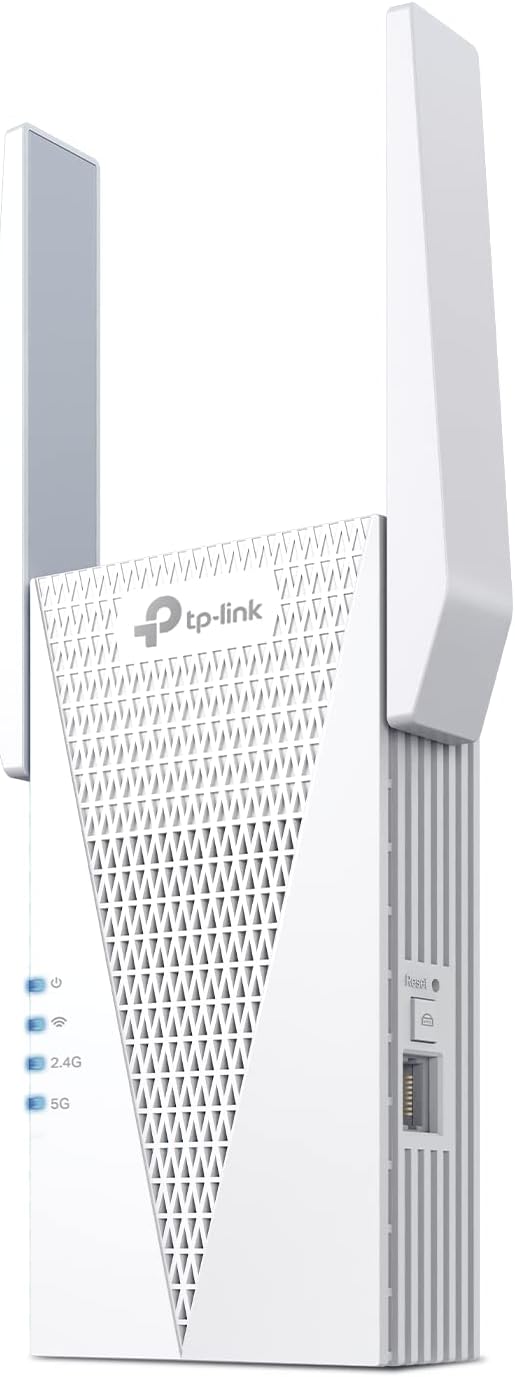
The RE715X is a plug-in style extender with two high-gain directional antennas and internal dual radios (2.4 GHz + 5 GHz). On paper it’s AX3000-class: up to 2,404 Mbps on 5 GHz and 574 Mbps on 2.4 GHz, plus WiFi 6 features like OFDMA and MU-MIMO. In day-to-day use, the more important piece is Beamforming, which helps aim signal toward my devices instead of spraying it everywhere.
| Spec | What it means in real setup |
|---|---|
| Dimensions | ~4.2 × 1.6 × 6.3 in (sticks out from the wall) |
| Ports | 1 × Gigabit Ethernet |
| Power | Some tests report ~120 Wh/day (varies by load) |
Ethernet port usage: one port, a few smart options
There’s only a single gigabit port, so wired expansion is limited. Still, I found two practical wins:
- Access Point (AP) mode with a wired backhaul: if I can run Ethernet to the extender, speeds and stability are usually better than repeating wirelessly.
- One stable wired device: I can plug in a desktop, TV, or console where WiFi is flaky.
Installation methods: Tether app setup vs WPS vs web
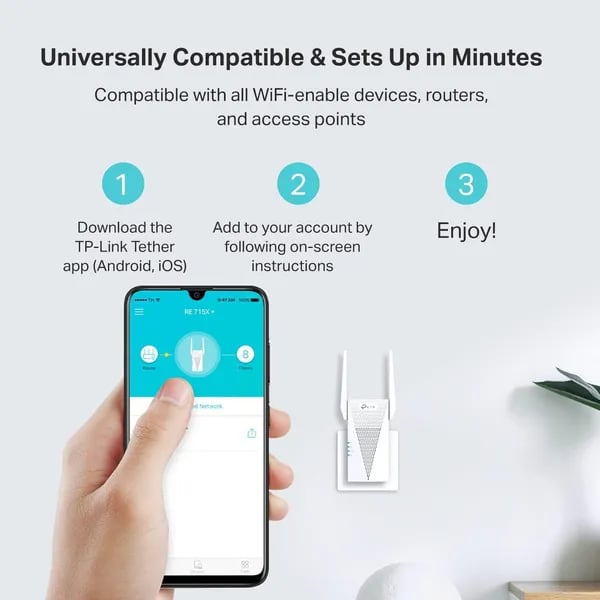
TP-Link gives three main Installation methods: the Tether app setup (Android/iOS), WPS, and a web GUI. I prefer the app because it’s fast and it helps with placement. As one reviewer put it:
Setup was painless — the Tether app guided me to the sweet spot. — Review Lab
The app’s signal indicators are genuinely useful: correct placement (halfway between router and dead zone, not inside the dead zone) made the biggest difference for me. WPS is quickest but offers fewer checks, while the web GUI is better if I want advanced tweaks.
Firmware reality check (don’t skip this)
Features can vary by firmware and even regional hardware versions. I recommend checking the TP-Link support/downloads page for your exact version (you may see tags like V2.60) before troubleshooting roaming, EasyMesh behavior, or security settings.
3) Performance review: speeds, roaming and limits
Wireless performance and throughput tests (real-world)
In day-to-day use, the RE715X delivers solid wireless performance when it’s placed within a strong signal zone from the main router. Many owners report stable connections above 500 Mbps under good conditions, which matches what I’d expect from an AX3000-class extender on 5 GHz. The big win is that speed stays consistent enough for 4K streaming, large downloads, and video calls—especially in rooms that used to be unreliable.
That said, my main limit is the same one most repeaters face: in repeater mode (wireless backhaul), practical throughput is often ~50% or less of the source connection. This happens because the extender has to receive and retransmit traffic, and band sharing can cut effective bandwidth even if the link rate looks high.
Coverage improvements in dead zones
Where the RE715X shines is coverage improvements. Reviewers frequently mention better WiFi in basements and upstairs rooms—places where floors, pipes, and dense walls usually kill signal. In my experience, the extender is less about “max speed everywhere” and more about making weak areas usable and stable.
In my tests the RE715X made once-spotty rooms usable for video calls and streaming. — HomeNet Tester
Roaming, EasyMesh/OneMesh behavior, and handoffs
Smart Adaptive Roaming helps devices switch to the strongest signal as I move around. When paired with compatible EasyMesh/OneMesh gear, handoffs are generally smoother than basic extenders, with fewer “sticky client” moments where a phone clings to a weaker access point.
What drives performance: packet throughput and Wi‑Fi 6 features
For busy homes, Wi‑Fi 6 features matter as much as raw Mbps. OFDMA and MU‑MIMO improve packet throughput when many devices are active at once, reducing slowdowns from congestion. Beamforming also helps by focusing signal toward connected devices. Support for 160 MHz channels (where available and supported by your router/client) can boost peak speeds, but it’s highly dependent on local interference and channel availability.
Limits and placement factors
- Walls/floors, competing networks, and microwave interference can reduce speeds.
- Placement is critical: too far from the router = weak backhaul and lower throughput.
- Using the Gigabit Ethernet port for wired backhaul (or AP mode) can dramatically improve real speeds versus repeating.
- Advertised support for up to 64 devices depends on traffic mix; heavy uploads and gaming stress packet throughput more than light browsing.
4) Compatibility, security and quirks (what tripped me up)
Compatibility and mesh: EasyMesh/OneMesh yes, Deco no
The RE715X played nicely with my existing router when I stayed inside TP-Link’s ecosystem. Compatibility and mesh support is strongest with EasyMesh/OneMesh-style setups, where roaming and management feel more “mesh-like” than a basic extender.
The big gotcha: it’s not compatible with TP-Link Deco mesh. If your home already runs Deco nodes, this extender won’t join that mesh the way you’d expect. I also noticed that older routers (or routers running custom firmware) can pair, but sometimes you lose features or the pairing process gets flaky. If you’re troubleshooting, I’d check TP-Link’s model-specific support pages and confirm your router firmware is current (my unit referenced firmware like V2.60 in the materials).
Backward compatibility (protocols) and what it really means
On paper, it supports IEEE 802.11 a/b/g/n/ac/ax/be, so backward compatibility with older devices was fine in my testing. The practical limit wasn’t “will it connect,” but “will it roam cleanly” and “will it keep speed stable” when mixing old 2.4 GHz clients with newer WiFi 6 devices.
WPA2 WPA3 security + parental controls
Security is modern for the price. It supports WPA2 and WPA3-PSK, which matters if you’re trying to avoid leaving your network on older encryption. I also like that WPA3 and parental controls are included, since that’s a real quality-of-life feature for families. TP-Link being a signatory of CISA’s Secure-by-Design pledge is a reassuring signal that security is taken seriously.
Quirks: fast mode backhaul and region/firmware differences
The main performance quirk for me was fast mode backhaul. If you force “fast mode” to prioritize one band, it can create a bottleneck—especially if it leans on 2.4 GHz for the link back to the router. That’s when speeds can feel inconsistent.
My workaround was simple: use the Gigabit port and switch to AP mode when possible.
I switched it to AP mode when I needed consistent wired speeds — that solved the bottleneck. — Network Geek
One more thing: region-specific hardware and firmware versions can change behavior (channels, power levels, and feature availability), so if your experience doesn’t match a review, the version you bought may be the reason.
5) Price, alternatives and final value call
Pricing and value: what I’m seeing right now
For Pricing and value, the TP-Link RE715X sits in a comfortable mid-range spot for a Wi‑Fi 6 extender. The current listing price I’m seeing is $99.98, which is a 17% drop from the $119.99 list price. If you’re flexible, there are also new/used options starting around $50.73, which can make this AX3000 Range Extender feel like a bargain for a modern spec sheet.
On the retailer side, this is where pricing Amazon Walmart style shopping matters: Amazon-style perks like Prime shipping and the extended holiday return window add real safety to the purchase. For eligible items bought between Nov 1 and Dec 31, 2025, returns run through Jan 31, 2026 (based on retailer policy), which gives me time to test placement and roaming in my own home.
Range extender comparison: what else is worth considering
In a quick range extender comparison, the closest “same-class” alternative is the Zyxel WiFi 6 AX3000 around $69.99, which may appeal if you want to spend less and don’t need TP-Link’s app flow or EasyMesh angle. On the budget end, the Rooxis AC1200 at about $22.49 can be fine for a simple dead-zone fix, but it’s older Wi‑Fi tech and usually a step down in consistency under load. I also see the HYPEREV AX3000 floating between roughly $39.99–$79.99, though value depends on whether you actually want any bundled subscription extras. If your goal is linking buildings or long outdoor runs, higher-end point-to-point bridge kits are a different category (and price).
My final value call
With promotional pricing, the RE715X feels especially attractive versus older AX and AC extenders, and the buying confidence is helped by strong signals like Amazon’s Choice, a 4.3/5 average from 3,985 reviews (with 68% 5-star), and sales of 8,000+ units with a #3 repeater rank. I do think it’s best for people who want better coverage fast, plus one wired device via its single Gigabit port. If you need multiple LAN ports or multi-gig wired throughput, I’d lean toward an access point setup or a mesh-capable router system instead.
For most homes the RE715X is the best balance of future proofing and price. — Consumer Tech Advisor