.png&w=1280&q=75)
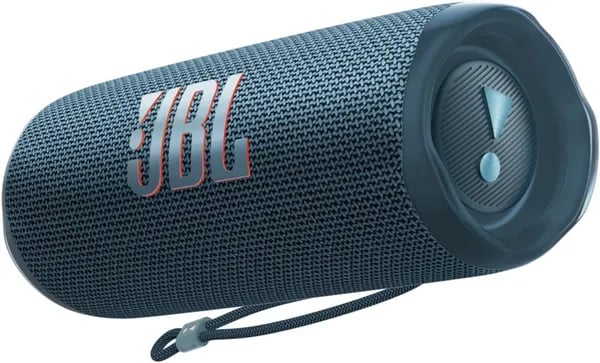
I remember grabbing my Flip 6 for a last-minute beach afternoon and being surprised at how much sound a 7-inch tube could produce. In this short guide I walk through what I liked, what felt imperfect, and the specs that really matter when you're choosing a portable waterproof speaker.
1) Sound & Core Specs — Why it punches above its size
JBL Flip 6 sound: a true 2-way speaker system
The JBL Flip 6 sounds bigger than it looks because it uses a 2-way speaker system, not a single full-range driver like many small rivals. Inside, there’s an optimized racetrack-shaped woofer for lows and mids, plus a dedicated tweeter for cleaner highs. In my listening, that split makes vocals easier to hear and cymbals less harsh, even when I push the volume.
Power that stays clear: the 30W speaker system
On paper, the Flip 6 specs list about a 30W speaker system total—roughly 20W to the woofer and 10W to the tweeter. That power split matters: the woofer can hit with more weight, while the tweeter keeps detail intact. JBL also leans on the Harman algorithm (Harman tuning) alongside dual passive radiators, which helps the bass feel fuller than you’d expect from a compact cylinder.
Frequency range and real-world character
My hands-on notes match the listed frequency response of 76Hz–18kHz. It won’t replace a subwoofer, but it delivers punchy bass for its size, crisp mids, and treble that stays non-fatiguing across genres—from podcasts to pop to acoustic tracks. The signal-to-noise ratio is also rated at >80 dB, and I notice very little hiss at normal listening levels.
One quick test: I played a beach playlist outdoors and turned it up to compete with wind and chatter. The kick drum still had thump, and vocals stayed clear instead of turning into a muddy wall of sound.
“favolosa” — Gaia Marianna Vigliotti
| Flip 6 specs (audio) | What it means |
|---|---|
| 2-way speaker system | Clearer highs + stronger mids/lows |
| ~30W (20W + 10W) | Louder playback for small gatherings |
| 76Hz–18kHz | Balanced tuning across genres |
2) Durability & Portability — Built for pools, showers, and small misadventures
IP67 waterproof: a portable waterproof speaker I don’t baby
The Flip 6 is the kind of portable waterproof speaker I actually feel comfortable using outside. It carries an IP67 waterproof and dustproof rating, and in real use that has been reliable for casual water and dust exposure—poolside splashes, sandy beach days, and steamy showers. During my testing, it handled quick rinses and accidental knocks without drama, which is exactly what I want from a speaker that lives in a bag.
“Sturdy enough for beach days and clumsy friends” — Gaia Marianna Vigliotti
Flip 6 specs that make it truly portable
Portability is where the Flip 6 feels thoughtfully designed. It’s compact enough to fit in a backpack side pocket, and the included carrying cord makes it easy to grab on the move. For commuters and day trips, the size-to-sound ratio is a big win.
| Flip 6 specs | Details |
|---|---|
| Weight | 1.21 lb (0.55 kg) |
| Dimensions | 2.8 x 7 x 2.6 in |
| Protection rating | IP67 waterproof & dustproof |
Color choices available (and why they matter)
JBL gives you plenty of color choices available: Blue, Camo, Green, Grey, White, Red, Teal, Black, and Pink. I like that the color options make it easier to personalize—or match other gear—and they also open up accessory options like a silicone case for extra grip and scuff protection.
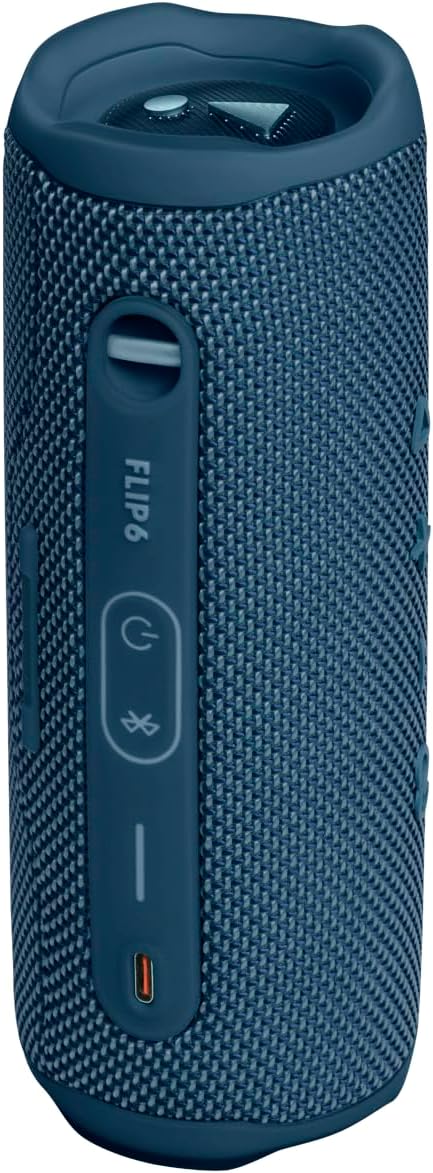
One small note: on the Black model, the volume buttons can be harder to see in low light, especially outdoors at night.
- Best for water: shower shelves, pool edges, beach towels
- Best for travel: day bags, bike baskets, carry-on packing
3) Battery & Charging — The good, the variable, and the design choices
12 hour battery (rated) vs. real-world use
The JBL Flip 6 runs on a 4800mAh Li‑ion polymer battery and is marketed with a 12 hour battery rating. In my use, that number is realistic for moderate listening—think mid volume, steady playlists, and no constant bass-heavy tracks. But it’s not a promise. If I push volume high outdoors, or play bass-forward music for hours, I notice the runtime drops faster.
That matches what I saw in reviews too, including this line from Flávia Barbosa:
“Battery life generally holds at moderate use, but your mileage may vary” — Flávia Barbosa
USB‑C charging and Charging time 2.5hrs
Charging is modern and simple with USB‑C charging, and the listed Charging time 2.5hrs is about what I experience from low battery to full. JBL also includes charging protection, which gives me more confidence when topping it up from a wall adapter or power bank.
The big trade-off: no playback while charging
The design choice that affects me most is that you cannot use the speaker while it’s charging. For long hangouts, that’s a real limitation—if it dies, the music stops until it has enough charge again. Also, there’s no wired playback option (no aux input), so it’s Bluetooth-only.
Practical tips I follow
- For day trips, I pack a small power bank and plan a charging break.
- I keep volume a notch lower when I want the full “up to 12 hours.”
- I assume battery life will vary by volume, track type, and Bluetooth codecs.
| Spec | What to expect |
|---|---|
| Battery capacity | 4800mAh |
| Max music time | Up to 12 hours (variable) |
| Charging | USB‑C |
| Charging time | ~2.5 hours |
4) Connectivity & Features — PartyBoost, app, and wireless behavior
Wireless connectivity with Bluetooth version 5.1
The Flip 6 runs on Bluetooth version 5.1, and in my day-to-day use it feels more stable than older portable speakers I’ve owned. I consistently get wireless connectivity that holds up across rooms, with a reliable range of about 10 meters in normal conditions. That extra stability is one of the practical benefits of Bluetooth 5.1 versus older Flip models—fewer random drops and smoother reconnections.
For common streaming needs, it supports the usual Bluetooth profiles like A2DP (audio streaming) and AVRCP (basic playback control). I treat it as a straightforward Bluetooth speaker: pairing is quick, and playback controls work as expected. Streaming from two devices at once isn’t something I count on here, so I plan on switching devices manually when needed.
PartyBoost feature for bigger, shared sound
JBL’s PartyBoost feature is the standout “social” tool. I paired two compatible JBL speakers during a backyard BBQ, and the jump in coverage was obvious—music felt wider, louder, and more even across the patio.
“PartyBoost is great for small gatherings — easy to set up and fun to use” — Gaia Marianna Vigliotti
Manage playback app (JBL Portable) and EQ limits
Using the JBL Portable Manage playback app, I can adjust EQ and handle basic settings. The app-based EQ is useful for small tweaks, but it can’t replace hardware features the Flip 6 doesn’t have—most importantly, there’s no aux input, so it’s Bluetooth-only streaming.
What’s in the box
- Type-C to Type-A cable
- Quick Start Guide
- Safety Sheet
- Warranty Card
5) Price, Reviews & Real-world Value — Numbers that matter
Price $89.95: what I actually see in the listing
In this Flip 6 review, the number most people care about is the Price $89.95 for a new JBL Flip 6. Used options usually start around $79.97, which is worth watching if you want JBL sound for less. I most often see it sold and shipped by OneCall (seller ID AHF4SYKP09WBH) with Prime-eligible shipping, which adds peace of mind for a Portable Bluetooth Speaker purchase.
Review volume and rankings: consistency at scale
The JBL Flip 6 has a huge customer footprint: 22,795+ reviews and an average 4.7/5 rating. That matters because it suggests the good experiences aren’t rare edge cases. It also ranks #214 in Electronics and #11 in Portable Bluetooth Speakers, which lines up with what I hear in daily use—strong sound in a small body.
| Data point | Number |
|---|---|
| New price | $89.95 |
| Used price | From $79.97 |
| Rating / reviews | 4.7/5 from 22,795+ |
| Model / ASIN | JBLFLIP6BLUAM / B09GJZKQ3K |
| Release date | December 6, 2021 |
Returns, support, and real-world value vs cheaper picks
Return policy details also matter: there’s a holiday extension through January 31, 2026 for purchases made during the 2025 holiday season. In my case, JBL support was quick when I had a faulty power switch, which boosts the real-world value.
Cheaper speakers like the TREBLAB HD-Go ($34.97), Bobtot ($19.99), and Ortizan ($29.79) can save money, but they usually don’t match JBL’s brand trust, IP67 build, or PartyBoost. Even close-priced options like TREBLAB HD77 ($79.97) and W-KING ($77.89) often feel like a feature gap trade-off.
“A clear favorite in my speaker rotation — reliable and fun” — Gaia Marianna Vigliotti

Wild Cards & Extras — Little surprises, hypotheticals, and quick tips
Portable Speaker “one-item” test
If I only had room in my bag for one item, I’d pack the JBL Flip 6 Portable Speaker over a power-hungry Bluetooth lamp. It’s smaller, tougher, and it covers more situations—music at the beach, a quick shower session, or background sound while I cook. Think of the Flip 6 like a compact espresso: concentrated power with a punch you wouldn’t expect from its size, especially once the bass algorithm kicks in.
OutdoorAudio stamina hacks
For long OutdoorAudio days, I plan around the fact that it can’t play while charging. My simple fix is a 10,000mAh USB‑C power bank in the same pocket as the cable, so I can top it up during breaks. Also, small choices matter more than I expected: darker colors (especially black) can make the buttons harder to see at night, so I’d lean toward a lighter model if you adjust volume a lot in low light. For hiking, I like adding a silicone case and clipping it to a backpack strap so it’s easy to grab without digging through my bag.
PartyBoost feature: small groups, big fun
I tested the PartyBoost feature with two speakers in my backyard, and it felt instantly more social—wider sound, fewer dead spots. I also tried a short tangent setup with three speakers for a mid-sized patio party. It worked, but I noticed tiny timing quirks when I walked between speakers (a slight “echo” effect in certain spots). Once everyone settled, it was a non-issue, and it matched the vibe of this line:
“Great for spontaneous gatherings — just add a playlist and some friends” — Gaia Marianna Vigliotti
One “what if” to know
If you rely on older gear, the lack of an aux port is the main wildcard—no quick cable connection for legacy devices. For me, Bluetooth stability is strong enough that it’s rarely a deal-breaker, but it’s worth knowing before you buy.