.png&w=1280&q=75)
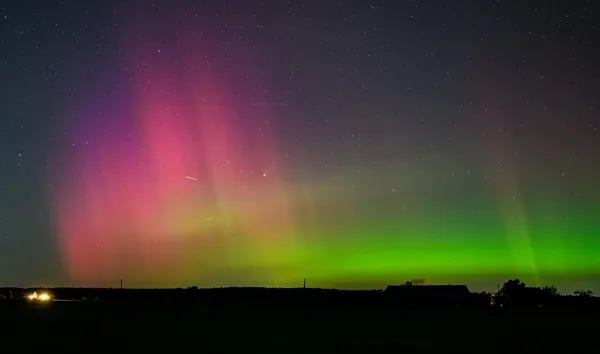
Imagine tucking into pumpkin pie while, just outside your window, the sky explodes in ethereal greens and purples. That's the scenario I can't help daydreaming about as Thanksgiving 2025 approaches. My family always jokes that I check NOAA alerts more religiously than I baste a turkey, and, this year, they might just begrudgingly thank me. Turns out, space weather has cooked up something special: a forecast for the Northern Lights to grace our skies on November 27th. This isn't hype—for once, the terms 'solar wind' and 'geomagnetic storm' are likely to dominate more conversations than stuffing versus mashed potatoes at my family's table. Let's unpack what makes this celestial show so uniquely timed, and perhaps a little magical.
1. A Stormy Recipe for Thanksgiving: Why This Aurora Matters
As I look ahead to Thanksgiving night, November 27, 2025, I feel a buzz of anticipation that’s hard to describe. This year, the holiday brings more than just family, food, and tradition—it brings the promise of a rare and beautiful natural show. According to the latest Aurora forecast November 2025 from NOAA’s Space Weather Prediction Center, a G1 (Minor) geomagnetic storm is expected to sweep across the Northern Hemisphere, lighting up the skies over ten northern U.S. states and parts of Canada. This isn’t just another aurora event; it’s a collision of science, sky, and serendipity that could make this Thanksgiving unforgettable.
NOAA Aurora Prediction Thanksgiving 2025: The Science Behind the Storm
What makes this year’s aurora so special? For starters, it’s not being triggered by a dramatic coronal mass ejection (CME), which is usually the culprit behind the most vivid auroral displays. Instead, this event is driven by persistent, high-speed solar winds—streams of charged particles that have been racing through space and are now set to interact with Earth’s magnetic field. NOAA’s OVATION model, which uses real-time solar wind data, has flagged the night of November 27 for “isolated periods of G1 (Minor) geomagnetic storming levels,” as their official forecast puts it:
"Chances for isolated periods of G1 (Minor) geomagnetic storming levels remain possible through 27 Nov." – NOAA Space Weather Prediction Center
In simple terms, a G1 geomagnetic storm (Kp=5) is considered minor, but it’s strong enough to bring the aurora further south than usual. This means that states like Alaska, Washington, Idaho, Montana, North Dakota, South Dakota, Minnesota, Wisconsin, Michigan, and Maine are all in the Northern Hemisphere aurora visibility zone. For many, this could be the best chance in years to see the Northern Lights dance overhead—right from their own backyard.
Why High-Speed Solar Winds Matter
Most auroras that make headlines are sparked by CMEs—huge eruptions from the sun that slam into Earth’s magnetic field. But this Thanksgiving, the show is powered by something subtler: fast, steady solar wind. These winds, when they hit Earth, can stir up our planet’s magnetic shield just enough to create shimmering curtains of color in the night sky. It’s a reminder that even without a solar “explosion,” our sun can still put on a spectacular show.
Thanksgiving Night: The Perfect Celestial Stage
The timing of this G1 geomagnetic storm November 27 2025 couldn’t be better. As families gather indoors, the sky outside will be setting up its own feast for the eyes. The nearly 50%-lit waxing gibbous moon will hang low in the southern sky, its soft glow acting as a gentle counterpoint to the drama unfolding in the north. But that’s not all—Saturn will be in close conjunction with the moon, creating a rare pairing that adds another layer of wonder to the night. Over the next few evenings, this moon-Saturn duo will grow even closer, offering a bonus for anyone who looks up.
Where to Watch: States in the Aurora’s Viewline
- Alaska (AK)
- Washington (WA)
- Idaho (ID)
- Montana (MT)
- North Dakota (ND)
- South Dakota (SD)
- Minnesota (MN)
- Wisconsin (WI)
- Michigan (MI)
- Maine (ME)
For those living in these states—or visiting family there—this aurora forecast is a golden ticket. NOAA’s real-time aurora visibility maps and apps like Aurora Now or My Aurora Forecast make it easy to track the storm’s progress and pick the best viewing spots. The darker your northern horizon, the more vibrant the aurora will appear, even during a moderate storm like this one.
Celestial Coincidence: Science Meets Serendipity
It’s not every year that Thanksgiving dinner is followed by a cosmic light show. The combination of a G1 geomagnetic storm, a nearly half-lit moon, and Saturn’s close approach is a recipe for skywatching magic. As I prepare my camera and check the forecast, I can’t help but feel grateful—not just for the chance to see the Northern Lights, but for the way science, nature, and family can come together on a single, unforgettable night.
2. Where and How: Chasing the Lights, Dark Sky Tips & Surprises
As Thanksgiving 2025 approaches, I find myself scanning maps and forecasts, plotting the perfect spot to witness the Northern Lights. This year, the science is on our side: NOAA’s Space Weather Prediction Center is calling for a G1 (Minor) geomagnetic storm, driven by high-speed solar winds, right as the holiday begins. The best part? The aurora forecast stretches across ten northern U.S. states and deep into Canada, making this one of the most accessible aurora events in recent memory.
Best Locations to View Northern Lights: From Alaska to Maine
If you’re wondering where to go, NOAA’s latest aurora viewlines point to a dream list for skywatchers. The best locations to view Northern Lights this Thanksgiving include:
- Alaska
- Washington
- Idaho
- Montana
- North Dakota
- South Dakota
- Minnesota
- Wisconsin
- Michigan
- Maine
I always say, “Get away from the city lights, and what was a barely-there shimmer turns into an explosion of color.” – Jamie Carter
Whether you’re in remote Michigan, chilly Alaska, or even that forgotten field behind your aunt’s barn, the secret is the same: find the darkest possible location with a clear view to the north. Urban light pollution can wash out even a strong aurora, so I rely on tools like the Light Pollution Map and Dark Sky Place Finder for last-minute scouting.
Aurora Visibility Alaska, Washington, Idaho: Real-Time Forecasts & Apps
The science behind the show is fascinating. This year, it’s not a solar flare but high solar wind speeds and the all-important Bz component of the interplanetary magnetic field that will decide the aurora’s fate. When Bz turns southward (below -5 nT), the odds of a vivid display skyrocket. I keep a close eye on real-time data using Aurora alert apps like Aurora Now, My Aurora Forecast, and Glendale Aurora. These apps pull the latest NOAA forecasts, Kp index, and Bz readings, sending instant alerts when conditions are right.
NOAA’s own 30-minute aurora visibility tracker is another must-have, especially if you’re chasing the lights in Alaska, Washington, or Idaho. These tools have saved me from many a wasted drive—and led to some unforgettable nights under the stars.
Dark Sky Tips: Finding the Perfect Spot
- Scout in advance: Use light pollution maps to find rural parks, lakeshores, or high ground with a clear northern horizon.
- Check the weather: Even the strongest aurora is invisible behind clouds. I always check local forecasts and satellite loops before heading out.
- Arrive early: Give your eyes time to adjust, and enjoy the waxing gibbous moon and Saturn’s close conjunction in the southeast as a bonus show.
Aurora Photography Tips: DSLR, Mirrorless & Smartphone Magic
Photographers—whether seasoned or smartphone-wielding—get a double thrill on nights like this. Even faint auroras, barely visible to the naked eye, can explode into vibrant greens, purples, and reds on digital sensors. Here’s how I capture the magic:
- DSLR/Mirrorless: Set ISO to 1600, aperture to f2.8, and exposure between 2–10 seconds. Shoot in RAW for easy editing.
- Smartphones: Use the main lens, switch to Night or Pro Mode, and stabilize your phone with a tripod, car roof, or fence post. Set exposure for 5–10 seconds if possible.
- Stability is key: Even a slight shake can blur the lights. I’ve used everything from tripods to a pile of books on a picnic table.
- Don’t trust your eyes alone: Sometimes, what looks like a grayish cloud will reveal itself as a neon arc in your photos.
Surprises in the Sky: Moon, Saturn, and More
This Thanksgiving, the sky offers more than just auroras. The waxing gibbous moon will hang low in the south, with Saturn glowing nearby—a rare conjunction that adds another layer of wonder to the night. I plan to capture both in the same frame, a cosmic feast to match the one on our tables.
With science, apps, and a little serendipity, this could be the Thanksgiving we remember for the lights that danced above us.
3. Space Weather Sleuthing: The Science (and Quirks) Behind the Storm
As Thanksgiving 2025 approaches, I find myself glued to NOAA’s Space Weather Prediction Center updates, tracking every twist and turn in the forecast for a possible Northern Lights display. The science behind this celestial show is as thrilling as the spectacle itself, and this year’s event is a perfect example of how space weather sleuthing blends hard data, real-time alerts, and a dash of unpredictability.
Solar Wind Speeds, Aurora Effects, and the Magic of Bz
Most people assume that a big aurora means a dramatic solar flare or a coronal mass ejection, but this Thanksgiving, it’s all about the solar wind. High solar wind speeds are expected to sweep past Earth, stirring up a G1-rated geomagnetic storm. But here’s where things get interesting: while the Kp index is the go-to number for measuring geomagnetic activity (with a Kp of 5 marking a G1 storm), it’s the Bz component that often makes or breaks an aurora chase.
The Bz component is a measure of the interplanetary magnetic field’s orientation. If Bz points north, Earth’s magnetic field acts like a closed door, blocking most of the solar energy. But if Bz swings south—especially to -5 nT or lower—it’s as though, in Jamie Carter’s words, “someone’s thrown open the doors to the Earth’s magnetosphere for the solar particles to dance through.” This southward orientation is the secret sauce for spectacular auroras, allowing solar energy to penetrate and ignite those shimmering curtains of light.
Why Bz Beats the Kp Index for Real-Time Aurora Forecasting
The Kp index is invaluable for understanding the overall scale of a geomagnetic storm, and it’s central to NOAA’s OVATION model, which visualizes aurora ovals and predicts where the lights might appear. But the Kp index is an average, updated every three hours. In contrast, Bz data is live and dynamic—meaning it can change in minutes, and with it, the chances of seeing an aurora can swing from zero to “grab your camera!” That’s why experienced aurora chasers watch Bz like hawks. A sustained Bz of -5 nT or lower is usually the green light for an unforgettable show.
I’ve learned this lesson the hard way. A friend of mine once insisted he could predict auroras better than any app, based on the ache in his bad knee. He was so confident, he bet dessert on it. That night, NOAA’s 30-minute aurora visibility forecast showed a sudden southward plunge in Bz, and the sky erupted in color—while my friend’s knee stayed stubbornly silent. Science: 1, Old Wives’ Tales: 0.
Forecasting Tools: For Planners and Procrastinators Alike
NOAA’s approach to aurora forecasting is a gift to both meticulous planners and last-minute skywatchers (I’ll admit, I’m often the latter). Their 27-day aurora viewline prediction tools let you map out potential viewing windows weeks in advance, while the 30-minute updates are perfect for those spontaneous, “let’s go now!” moments. Apps like Aurora Now, My Aurora Forecast, and Glendale Aurora pull in live Bz and solar wind data, sending real-time alerts that can mean the difference between a missed opportunity and a night to remember.
The OVATION model, meanwhile, offers a visual snapshot of where the aurora oval is likely to be strongest. Combine that with the Kp index and live Bz readings, and you have a toolkit that’s as close to a crystal ball as space weather gets. Still, the quirks of solar wind mean there’s always an element of surprise—no two aurora chases are ever quite the same.
Conclusion: Science, Serendipity, and the Thanksgiving Sky
As I prepare for Thanksgiving under the Northern Lights, I’m reminded that the beauty of this event lies in both its predictability and its mystery. The science—solar wind speeds, Bz component solar energy penetration, Kp index geomagnetic activity, and aurora viewline prediction—gives us the tools to chase the lights with confidence. But it’s the quirks, the sudden shifts in Bz, and the thrill of real-time alerts that keep the experience magical. Whether you’re a planner or a procrastinator, a scientist or a stargazer, this Thanksgiving offers a rare chance to look up, connect with the cosmos, and maybe, just maybe, win a family bet or two. Here’s to clear skies and a night of wonder!